
The Tree of Supplier Engagement: A New Framework for Supply Chain Engagement Strategy
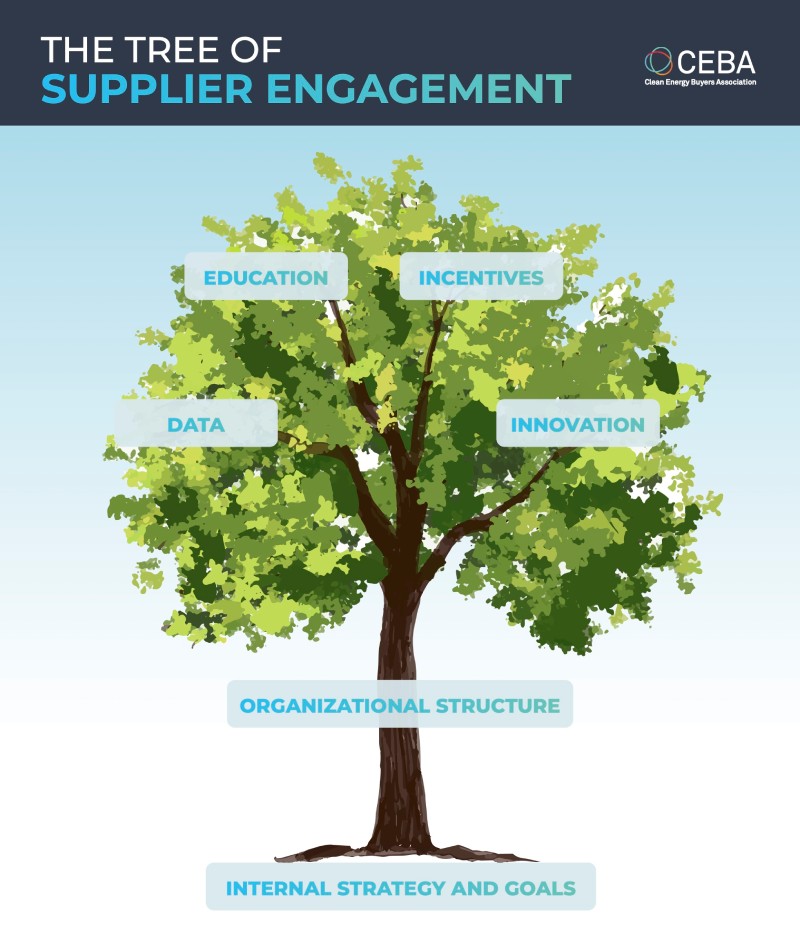
When talking about supplier engagement and decarbonization, people often default to metaphors like “pathways” or “roads.” These suggest a linear progression, with a clear starting and stopping point. In reality, supply chain engagement is anything but linear: it is a dynamic, ongoing, iterative process, shaped by each company’s unique priorities, maturity level, and overall decarbonization philosophy.
Here’s another way of thinking through supply chain engagement programming.
The Roots: Your Internal Strategy
A healthy tree needs strong roots. In this framework, the roots represent a company’s internal decarbonization strategy.
This is the “why” — your overarching sustainability goals, motivations, and approach to decarbonization. Your supplier engagement efforts will be grounded in these foundational goals and commitments.
Consider:
- How does supplier engagement and decarbonization align with or advance your climate goals?
- What do you need from your suppliers to meet your goals?
- How do your company values shape the way you engage externally?
The Trunk: Your Organizational Structure
The trunk supports and connects all parts of the tree. In this case, that is a company’s internal structure and alignment.
When thinking of the key stakeholders for supplier engagement, we often jump right to the suppliers themselves, but don’t forget about the internal players. Think about who in a company ought to be involved to ensure the success of your supplier engagement program, and how the different internal teams interact. Is sustainability embedded directly into procurement, or are these functions kept separate? What role do your legal, finance, and communications teams need to play?
Consider:
- Which teams need to collaborate to drive action?
- How can you structure your supplier engagement program to benefit multiple departments and help other teams reach their goals?
- What internal approvals or buy-ins are required?
The Branches: Core Engagement Activities
Once the roots and trunk are firmly established, the supplier engagement strategy can branch out. The branches of the tree represent the four core categories of supplier engagement activities: Data, Education, Incentives and Enforcement, and Innovation.
Data: Understanding your suppliers
The information you receive from suppliers will shape your understanding of engagement. You will need to collect and maintain high-quality data to pinpoint emissions hotspots across your value chain and understand the maturity level of individual suppliers in their own decarbonization journey. Ask your appropriate stakeholders targeted questions to collect robust data. Create systems to manage and analyze your data effectively.
Consider:
- How can you streamline requests?
- Do you have the right contacts within your supplier companies?
- How will you manage and analyze data?
Education: Setting up your suppliers for success
Empower your suppliers by delivering the knowledge and tools they need to succeed. Whether through custom training, curated resources, or strategic partnerships, your role is to enable your suppliers to set and achieve decarbonization targets.
Consider:
- How can you help your suppliers set and meet their own goals?
- Will you create your own training, leverage a strategic partner to develop bespoke resources, or share existing free materials about clean energy?
Incentives and Enforcement: Motivation and accountability for your suppliers
Accelerate progress by defining how you will encourage suppliers to act and what you will do if they don’t. Incentives may look like public recognition, favorable procurement and financial terms or status, dedicated support, or visibility and access to executives. Enforcement mechanisms could include financial penalties or noncompliance status, enforced through contract terms or codes of conduct. The key here is finding the right balance of incentive “carrots” and enforcement “sticks.”
Consider:
- What mix of incentives and enforcement mechanisms makes the most sense for your industry or business?
- Will you adjust your approach based on supplier maturity and readiness?
Innovation: The next frontier of supplier engagement
Take bold steps to accelerate impact and action through collaboration and innovation. Buyers are increasingly taking action in partnership with or directly on behalf of suppliers. Some are partnering with peers in their industry, going beyond the traditional guidance to make significant decarbonization progress on their Scope 3 electricity emissions.
Consider:
- Would a collaborative effort work well in your industry?
- Could you serve as the anchor offtaker on a project or help your suppliers aggregate their demand?
- Would you ever procure clean energy and retire renewable energy credits on behalf of your suppliers?
The Tree of Supplier Engagement: More Than a Checklist
The beauty of the Tree of Supplier Engagement is that it can grow and change over time. Trees are inherently resilient and adaptable — the best supply chain programs are built to be that way, too. Maximize your impact by tailoring your strategy to different levels of supplier readiness, embracing flexibility and innovation, and leveraging strategic collaborations (both internally and externally).
While there is no single right way to engage suppliers, cultivating strong roots, a sturdy trunk, and intentional branching can lead your company to effective and impactful supplier engagement.
In 2026, CEBA will continue to explore the components of the Tree in more detail with case studies, expert guest speakers, and group discussions for peer-to-peer learning. Join us on January 28, 2026, at 2 PM ET for our first virtual meeting of the year as we kick off a productive and exciting year of supply chain activation programming.
Would you use this framework to map out your supplier engagement? What does your Tree of Supplier Engagement look like? Email us at supplychain@cebuyers.org with your reactions to keep the conversation growing.